
South Park Characters: An Illustrated Guide to Clear Social Posts
Learn to identify South Park characters and explain them in clear social posts, with 12 illustrated profiles, crop advice, and useful caption examples.

A character post works best when a reader can tell who is pictured before opening the caption. South Park characters make that principle easy to see. Kenny's orange hood, Kyle's green hat, and Cartman's broad red jacket each communicate identity quickly. The challenge in a social post is keeping those clues visible while giving the image enough context to mean something. For a cartoon subject for your next post, try South Park Character Creator.
This guide presents images from the South Park Public Library and explains how to write useful descriptions around them. It is a fan reference, with practical observations about cropping, captions, and character comparisons. The aim is a post that helps someone recognize a character, rather than a caption padded with names and search phrases.
Give each image one clear job
A portrait can identify a character. A pair of portraits can explain a difference. An episode still can establish a moment in a story. Decide which job you need before assembling a carousel. Combining all three without labels makes readers guess why the pictures belong together.
Cartman: preserve the recognizable outline

The broad jacket, turquoise cap, yellow hat trim, and yellow mittens belong together in this Cartman portrait. A very tight face crop would remove much of that information. A useful caption can identify Eric Cartman and point out his outfit without repeating the same name in every sentence.
Stan: let the accent color connect the image

Stan's red pom-pom, hat band, and gloves repeat a color around a quieter brown coat. That detail gives a short caption something specific to explain. “Stan Marsh in his blue-and-red hat” is more useful to a new reader than a generic description of a cartoon boy.
Kyle: keep the earflaps in the crop

Kyle's hat extends to both sides of his face. Cropping those flaps away weakens an important identifying feature. Leave room around the head and retain some of the orange jacket, so the picture still communicates the green-and-orange combination that separates Kyle from the other central boys.
Kenny: leave room for the hood

Kenny's face is already tightly enclosed by his orange hood. The complete hood opening and drawstrings explain the image better than an enlarged pair of eyes. A caption should describe the visible portrait; it need not retell the character's entire history to make a single social card useful.
Build comparisons that reward a second look
Butters and a small hair silhouette

Butters' short blond hair and turquoise shirt make a spare, open design. He provides a useful comparison with the winter hats above. One card could ask readers to notice what replaces the hat as the main recognition clue: the hair shape becomes the answer, with the shirt supporting it.
Tweek and a more irregular outline

Tweek's blond hair spreads in multiple directions, unlike Butters' smaller tuft. His olive shirt also has an uneven closure. A side-by-side comparison can explain these visible differences without attaching exaggerated personality claims to a neutral portrait. Describe what the image shows before interpreting how it feels.
Wendy and the role of long hair
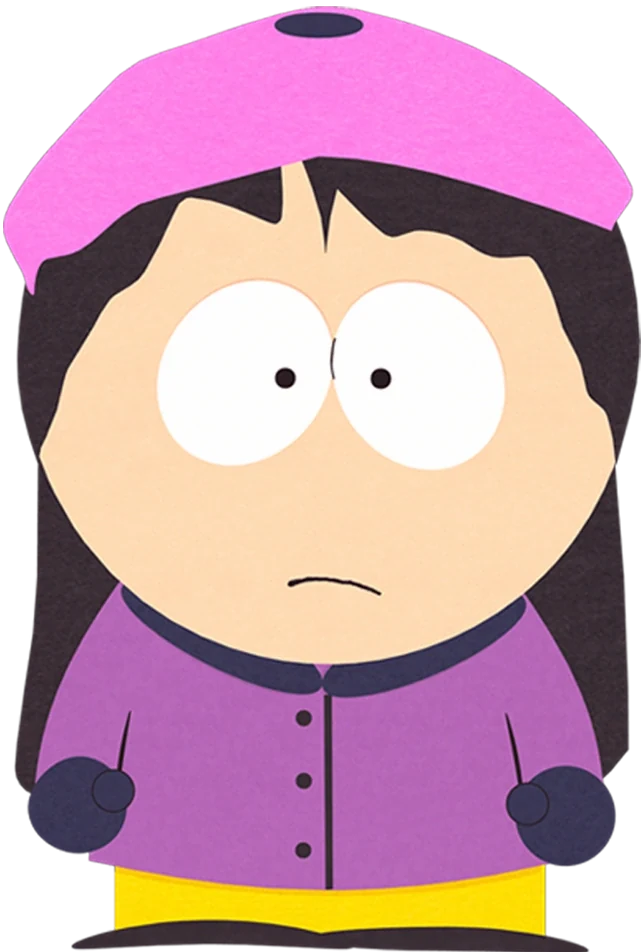
Wendy's dark hair continues down beside the purple jacket, while a pink beret caps the figure. A shoulder crop may hide the hair's full length. If your post is about silhouette, use more of the body; if it is only a name-and-face introduction, explain the narrower purpose.
Bebe and a contrasting frame

Bebe's fuller blond hair frames the face differently from Wendy's dark, straighter shape. The red top gives the lower portion a strong color block. These two images suit a comparison about hair and framing, rather than a vague ranking of which character has the “best” design.
Include the wider cast accurately
Tolkien Black

The yellow T on Tolkien's purple shirt is a useful detail to identify in a caption. Use the character's name as Tolkien Black. A post can teach readers that name while describing the portrait, without reproducing outdated labels that may still appear in older image filenames.
Craig Tucker

Craig's blue outfit and yellow pom-pom distinguish him from Kyle, despite both wearing earflap hats. A comparison card should keep the full hats visible and name both characters. This answers a real identification question; placing two similar portraits together without an explanation would leave the reader to infer your point.
Jimmy Valmer

Jimmy's yellow top and crutches are visible in this full-body image. Keep enough space beside the figure to show the supports. A good introduction names Jimmy and describes the picture naturally. Avoid a crop or caption that reduces the character to a single physical feature.
Randy Marsh

Randy is shown in a farmer outfit with a brimmed hat and plaid shirt. Label that costume clearly. This image is useful for a post about character variations, but it should not be presented as proof that every Randy portrait uses the same clothing or setting.
Write captions for people who have not seen the show
Start with the character's name and one visual observation. Add a second sentence only if it answers a likely question. A caption such as “Kyle's green earflap hat creates a wider head shape than Stan's knit cap” gives the reader something to see. A string of disconnected phrases such as “South Park maker, characters, funny avatar” does not.
Put identification in the caption and a literal image description in the alt text. The two can overlap in meaning, but they serve different reading needs. For a carousel, make each card understandable on its own: social platforms may show a later image first, and readers may share only one slide.
If your next step is an original avatar, a South Park character creator brief should describe your character's own clothing, shape, and role. A South Park character maker is easier to direct with “a quiet courier with a mustard coat and round blue helmet” than with a list of existing cast names. Treat that as a planning example; generated results will still need inspection. Explore your brief from the homepage or see other illustrated topics in the blog. Choose one clear subject rather than a crowded composition when you try South Park Character Creator.
A four-card carousel plan
A useful introductory carousel could open with the four central boys, then compare Kyle and Craig, followed by Butters and Tweek, and finish with a clearly labeled outfit variation such as farmer Randy. The sequence moves from familiar names to specific visual differences. Each card answers a question instead of merely adding another portrait to the collection.
Write the caption after choosing the pictures. For the hat comparison, a direct line could be: “Kyle pairs a green earflap hat with an orange jacket; Craig's hat and jacket are blue.” Keep the character names beside the images so a reader does not need to infer left and right from the text alone. For the final card, identify Randy's costume before discussing its details. A small, well-labeled selection is easier to follow than a crowded grid whose caption tries to explain every character at once.
Keep episode references separate from portraits

The South Park World of Warcraft topic centers on Make Love, Not Warcraft, in which a powerful player repeatedly kills the boys' game characters. Cartman rallies Stan, Kyle, and Kenny around a plan to build their strength and defeat him. It is an episode-specific story, distinct from a general cast introduction.
The computer-lab frame shows the boys after their appearances have changed. Familiar clothing still provides identification cues, including Kyle's green hat and Kenny's orange hood. Cartman is in the red jacket but has no cap here. A caption should explain that context rather than call the picture a standard character portrait.
For a South Park maker carousel, put an episode card after the ordinary portraits and label the transition. The comparison then gives readers a reason to notice the altered appearances, instead of leaving them to wonder why the final image looks different. To develop a cartoon subject for your next post, try South Park Character Creator.